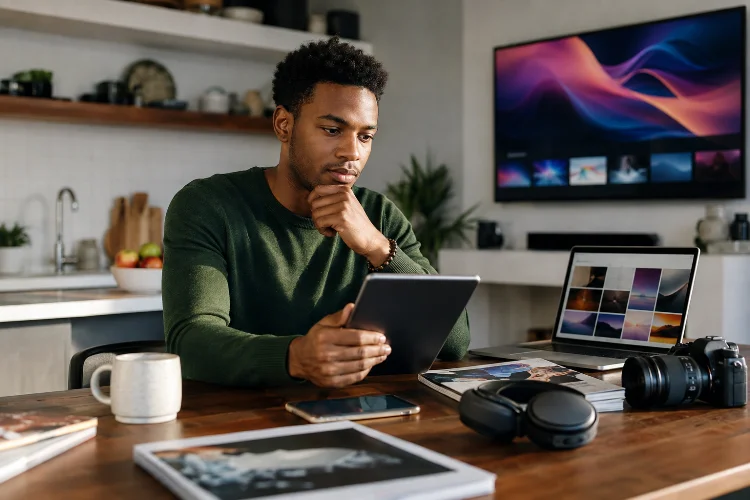
From the moment you check your phone in the morning, you are surrounded by information. News headlines, TikTok videos, advertisements, podcasts, influencer posts, memes, and AI-generated content all compete for your attention.
Some are informative. Others are designed to persuade, entertain, sell, or simply make you click.
This is why media literacy has become such an important part of critical thinking. UNESCO describes media and information literacy as a set of abilities that helps people access, analyze, evaluate, and use information critically and responsibly.
Being media literate does not mean automatically distrusting journalists, influencers, companies, or social platforms. It means understanding how media works and asking sensible questions before accepting or sharing what you encounter.
In daily life, these habits can help you identify weak claims, recognize emotional manipulation, compare sources, understand bias, and make better-informed decisions.
In a world where anyone can publish content instantly, knowing how to think about information is becoming just as important as having access to it.
1. Media Literacy Helps You Separate Information From Persuasion
Not every piece of content has the same purpose.
A news report may aim primarily to inform. An advertisement wants you to buy something. A political campaign tries to persuade you. An influencer video may combine entertainment, personal opinion, and sponsored promotion in the same post.
Media literacy teaches you to ask:
“Why was this content created?”
That question can dramatically change how you interpret what you see.
Imagine watching a video titled “The Five Supplements Everyone Needs.” If the creator also sells those supplements, the commercial relationship does not automatically make the advice false. It does, however, give you an important reason to inspect the evidence more carefully.
The News Literacy Project recommends identifying the purpose of information and distinguishing among content designed to inform, persuade, entertain, or sell. Its educational framework also emphasizes recognizing branded content and evaluating source credibility.
Critical thinking becomes stronger when you understand what the creator wants from you.
2. It Makes Source Evaluation a Daily Habit
A professional-looking website can still publish unreliable information.
Likewise, a viral social media account may have millions of followers without having expertise in the subject it discusses.
Media literacy encourages you to look beyond appearance.
Who created the information? What qualifications do they have? Does the source have a reputation for accuracy? Are claims supported by original documents, research, or identifiable experts?
One especially useful technique is lateral reading. Instead of staying on an unfamiliar website and studying what it says about itself, open another tab and investigate what independent sources say about it.
Professional fact-checkers commonly use this approach when evaluating unfamiliar online material, and media-literacy programs increasingly teach it as a practical verification skill.
Think of it as checking someone’s references before trusting their résumé.
You are not assuming the source is bad. You are simply verifying its credibility before giving it confidence.
3. Media Literacy Makes Misinformation Easier to Spot
Misinformation is not always obviously ridiculous.
The most convincing false content often contains something believable: a real photograph with the wrong caption, an authentic statistic presented without context, or a genuine quotation attached to a misleading conclusion.
That makes verification important.
The American Psychological Association notes that misinformation can spread because of psychological factors including confirmation bias, emotional reactions, social identity, and repeated exposure.
Imagine seeing a shocking video claiming that a major event happened “today.”
Before sharing it, a media-literate reader might search for the same event elsewhere, check when the video first appeared, and look for reporting from established sources.
Sometimes a thirty-second search reveals that the video is actually five years old.
That pause matters becuase social media rewards speed and emotional reaction, while verification usually requires slowing down.
Better critical thinking begins when “Should I share this?” comes after “Is this actually true?”
4. It Helps You Recognize Emotional Manipulation
Emotion is not automatically evidence of manipulation. Good journalism, documentaries, and personal stories naturally produce emotional responses.
The problem appears when emotion replaces evidence.
Consider a headline saying:
“This Common Household Product Could Be Destroying Your Family’s Health!”
The wording is designed to create anxiety before you have seen any evidence.
Fear, outrage, disgust, and excitement can all make information feel more urgent and memorable. APA resources on misinformation specifically encourage people to recognize emotional content and evaluate it more objectively.
A useful media-literacy habit is to notice your reaction before acting on it.
If a post makes you immediately furious, ask:
“What exactly is being claimed?”
“Where is the evidence?”
“Would this still seem convincing if the emotional language were removed?”
The stronger the emotional reaction, the more valuable a short verification pause can become.
5. Media Literacy Helps You Understand Framing and Bias
Media does more than tell us what happened. Choices about headlines, images, quotations, statistics, and context can influence how an event is understood.
This is known broadly as framing.
Imagine unemployment drops from 6% to 5%.
One headline could say:
“Unemployment Falls as Labor Market Improves.”
Another could say:
“Millions Remain Without Jobs Despite Latest Employment Figures.”
Both might contain technically accurate information, but they emphasize seperate aspects of the same situation.
Media literacy does not require assuming that every example of framing is dishonest. Every article has limited space, so editors inevitably decide what to emphasize.
Critical thinking means noticing those choices.
Ask which voices are included, which perspectives are missing, what comparison is being used, and whether alternative interpretations exist.
UNESCO connects media and information literacy with the ability to analyze information critically, recognize bias, and participate more responsibly in digital environments.
6. It Helps You Understand How Algorithms Shape What You See
Your social media feed is not a neutral window into the world.
Platforms typically personalize content based on factors such as your previous activity, engagement, interests, and predicted preferences.
This means two people can open the same platform and encounter very different versions of what appears important or popular.
The News Literacy Project includes understanding how algorithms personalize information among its core news-literacy competencies. It notes that personalization can create both benefits and potential problems.
Suppose you watch several videos about a particular conspiracy theory out of curiosity.
The platform may interpret that attention as interest and recommend more similar content. Soon, the theory can appear much more widespread than it really is simply because your feed repeatedly shows it.
A media-literate person remembers that frequency in a personal feed does not equal frequency in the real world.
Your timeline is personalized content, not a scientific sample of public opinion.
7. Media Literacy Strengthens Evidence Evaluation
One major connection between media literacy and critical thinking is the ability to distinguish a claim from the evidence supporting it.
Suppose a viral post says:
“Scientists have proven that drinking coffee doubles your memory.”
A critical reader should immediately wonder what the research actually found.
Did scientists measure long-term memory? How many participants were involved? Was the study conducted on humans? Did it find correlation or causation? Does “double” accurately represent the results?
The News Literacy Project’s credibility framework recommends examining authenticity, source, evidence, context, and reasoning when evaluating information.
This is particularly useful when scientific studies are simplified into dramatic headlines.
A study might report a modest association under specific conditions, while the headline transforms it into a universal rule.
Media literacy encourages you to trace claims closer to their original source instead of relying entirely on summaries.
8. It Reduces the Power of Confirmation Bias
One of the biggest obstacles to critical thinking is confirmation bias: our tendency to favour information that supports what we already believe.
Media environments can make this problem worse.
If you consistently follow creators who share similar opinions, interact with posts you agree with, and ignore opposing sources, personalized recommendation systems may give you increasingly familiar viewpoints.
Eventually, your beliefs can seem almost universally accepted.
APA media-literacy guidance specifically identifies recognizing personal biases as an important defense against misinformation.
A useful habit is deliberately checking credible sources that approach an issue from different perspectives.
This does not mean treating every opinion as equally reliable.
Instead, it means asking whether you are evaluating evidence consistantly. Would you accept the same quality of evidence if it supported the opposite conclusion?
That question can reveal how much your existing beliefs are influencing your standards.
9. It Encourages You to Pause Before Sharing
Media literacy is not only about what you consume.
It also affects what you distribute.
Sharing a misleading headline, manipulated image, or false statistic can spread misinformation even when you did not create it.
Research summarized by the APA suggests that interventions encouraging people to think about accuracy before sharing information can reduce some misinformation-sharing behavior, although the effectiveness of different approaches varies.
More recent APA reporting on five online experiments involving 2,509 social media users also found that asking people to consider the ethical implications of sharing clearly false headlines reduced their willingness to share them.
Before posting something, try three quick questions:
Is it accurate?
Do I know where it came from?
Have I checked the original context?
You do not need to investigate every funny meme like a detective. But when information could affect someone’s reputation, health, finances, or important decisions, verification becomes much more importent.
How to Practice Media Literacy Every Day
You do not need a formal media-studies course to improve your skills.
Start with small habits.
When a surprising headline appears, read beyond the headline. When an unfamiliar account makes an extraordinary claim, investigate the source. When a photograph seems suspicious, check whether reputable outlets show the same image in the same context.
The News Literacy Project recommends practical verification tools such as lateral reading, reverse image searches, critical observation, and checking information before sharing it.
Most importantly, become comfortable saying:
“I don’t know whether this is true yet.”
That sentence is not a failure of knowledge.
It is often the beginning of good critical thinking.
Understanding how media literacy supports better critical thinking in daily life means recognizing that consuming information is an active process. Media-literate people do not simply absorb headlines, videos, statistics, and social posts.
They question sources, examine evidence, notice framing, understand personalization, and verify important claims before accepting or sharing them.
These habits are increasingly valuable as social media, generative AI, advertising, journalism, and entertainment overlap in the same digital environment.
The next time something online makes you instantly shocked, excited, or angry, resist the urge to react immediately.
Check the source, search for independent confirmation, and look at the original context. A few extra minutes of media literacy can lead to much better judgment.